

In 1897, Nikola Tesla stood at a banquet in Buffalo and told a room full of industrialists that the newly electrified city was “sure to become one of the greatest industrial centers of the globe.” Buffalo believed him, built the infrastructure, and rode it for decades. Then the money, the talent, and the story moved on, and today Buffalo is a case study in what happens when a region wins a technological lottery and never builds the machinery to keep winning.
The lesson economic development offices should take from that is not that Buffalo got unlucky; it is that Buffalo had one of the three Ps and missed the other two.
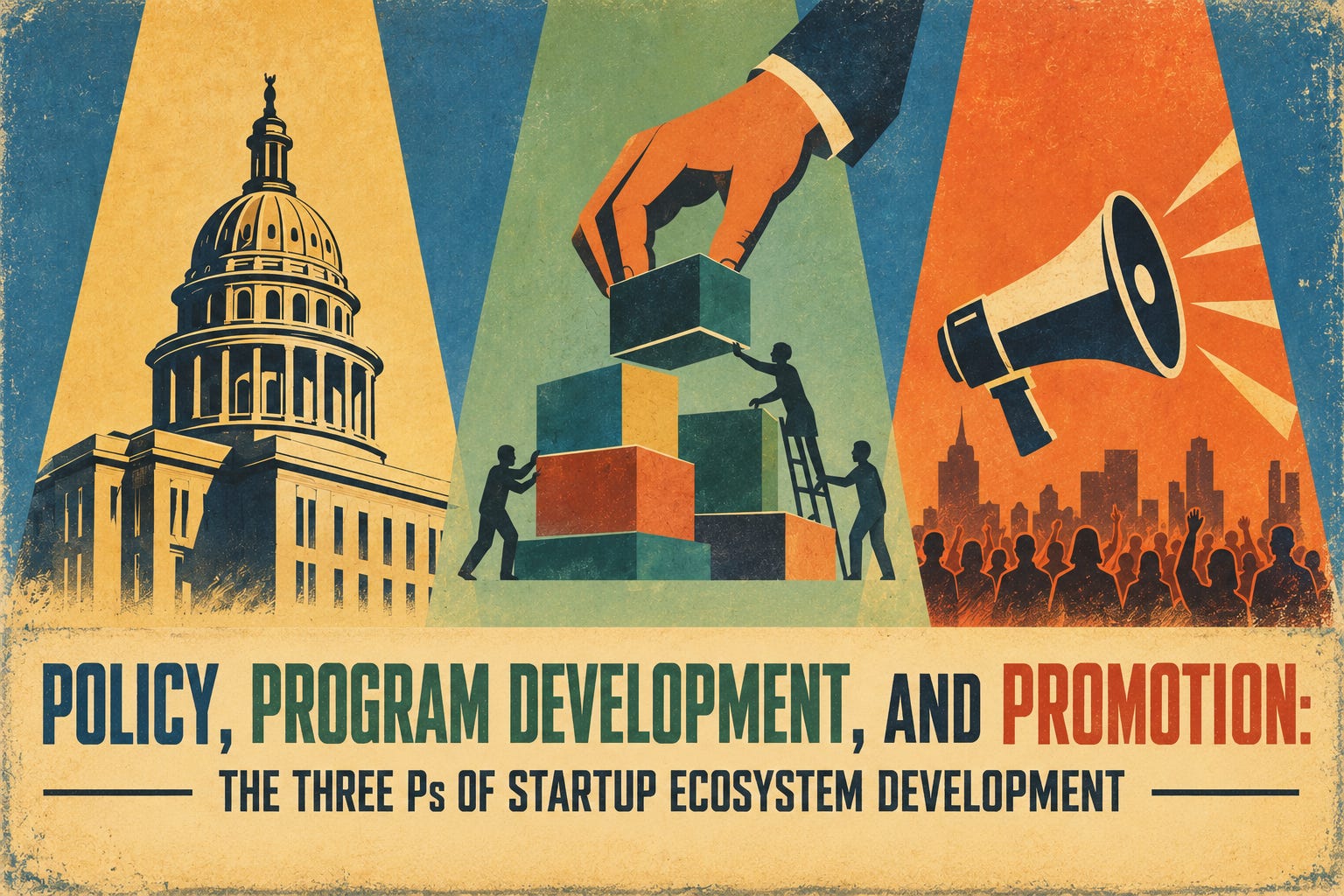
Most economic development offices are running one, maybe two, of the three functions that actually grow an entrepreneurial economy, and they are almost always running the wrong one hardest. They build a program, cut a ribbon, and call it an ecosystem. The playbook that works is simple but probably not how the org chart is designed; it is Policy, Program Development, and Promotion, run together, in that order, forever.
Cities do not create companies; conditions do. These three Ps are the conditions.
Policy: Public Affairs Needs the Loud Seat, Not the Ceremonial One
Start with what makes everything else meaningful or futile, because if you get this wrong, nothing else matters.
New and young firms, not big established employers, create almost all of the net new jobs in the economy. This is not an opinion held by startup people who want more attention; it is the finding of Haltiwanger, Jarmin, and Miranda in the Journal of Economic Perspectives, whose analysis of Census Bureau data on the entire U.S. economy shows that startups and young businesses account for roughly 70 percent of gross job creation and disproportionately drive net job creation, while mature firms are, on balance, actually net job destroyers. “Net job creation” is the number that matters because we’re talking about after we subtract every layoff, closure, and relocation from every hire; it is the only jobs number that means anything, and startups own it.
Sit with that, because your economic development office has been organized against it for a century.
Every incentive package written to lure an existing corporation to relocate its headquarters is, in net jobs terms, a subsidy paid to a category of firm that destroys jobs on average. The Center for American Entrepreneurship, the nonpartisan Washington policy shop founded by John Dearie to put this research in front of legislators; startups, “account for virtually all net new job creation,” and yet, as they noted on the reintroduction of the Startup Act, “the engine of innovation, growth, and job creation is breaking down.”
A region that keeps optimizing to recruit big employers while startup formation declines is not being cautious; it is actively destroying the only jobs that compound.
So, policy is not the paperwork that happens after the ecosystem exists. Policy is the seat, and right now the seat is empty or filled by someone who thinks “innovation” is a coworking space with meetups. Public affairs officials and startup development organizations need the prominent chair at the legislative table, and they need to use it to correct three things lawmakers get wrong by default.
Startups are not small businesses, and the statute treats them as the same thing. A dry cleaner and a seed stage AgTech venture have opposite capital structures, opposite risk profiles, and opposite growth math; writing them into the same tax, grant, and investment language guarantees the policy fits neither. Define startups separately in the statute or watch every downstream program inherit confusion. I have argued the full separation of startups from small business in policy at length, because it is the reform that unlocks the rest.
Regulation is a founder’s tax, and nobody at the table is pricing it. A regulation that a Fortune 500 company absorbs because of a compliance department and legal team, is an existential cost to a startup of four people; the same rule is a rounding error for the incumbent and a wall for the entrant (which is exactly how incumbents like it).
Tech and innovation are foreign languages to most lawmakers, and that is a fixable staffing problem. When your legislator’s frame of reference for “the future economy” is the last big semiconductor plant that opened (or worse, data center?), the ecosystem builder who could translate is not in the building; Dearie built an entire organization because and shared with John Belizaire, then CEO of Soluna Computing, when he started fixing this in 2022, that there’s no organization in Washington DC that is focused specifically on the importance of startups.
The policy job is legislative, and it is specific; bills that separate startups from small businesses, that treat venture capital as the portfolio math it is rather than as economic development, and that measure their own success by new firm formation. Supporting organizations like CAE is not lobbying for a special interest; it is putting the jobs research in the room where the incentive dollars get allocated, so those dollars stop flowing to the firms that shed jobs.
This is policy FOR entrepreneurs and startups.
Program Development: Stop Franchising the Broken Model
This is the hard one because most cities feel productive here, while, frankly, accomplish the least.
The reflex, when a region decides to “do startups,” is to buy an accelerator, because the accelerator is the thing that looks like startup activity; there is a cohort, a demo day, a photo. The problem is that the average accelerator does not accelerate, and we have known this from the research for a decade.
Read Yael Hochberg’s work in Innovation Policy and the Economy if you’re angry at me for being the messenger; she is drawing on the Seed Accelerator Rankings Project she runs out of Rice and MIT.
Reviewing the studies that compared accelerator graduates to matched companies that did not go through one, Hochberg reports that “the analysis reveals no statistically significant average accelerator effect in the speed at which companies reach the three key milestones examined, though statistically significant differences on certain measures exist for some of the top-ranked programs.” Capisce? a handful of elite programs move the needle, and the average program does nothing measurable, which means the accelerator your city is about to pay again falling short of the impact they claim.
Traditionally speaking, the accelerator model was engineered for one founder in one place at one moment, and copied by people who never diagnosed why it worked. Arguably, the first accelerator, Y Combinator, comes from 2005, with Techstars to 2007 in Boulder; their design is built around a dense pool of tech founders, a standing roster of investors who show up to demo day with checkbooks, and a mentor network of people who have actually built and sold startups. Drop that structure into a region that has none of those inputs and you have kept the curriculum without the ecosystem that makes it work. The curriculum teaches founders to “talk to customers” as though a customer of an existing product could tell you how to build a product that does not exist yet; the order of operations is inverted, emphasizing pitch polish and backloading the market discovery that should have come first.
But we’re not here to blame the good intention of people trying to start accelerators; separate the symptom from the cause; the surface symptom is “accelerators fail” and the root cause is something a region can actually fix. The failure is not that programs go out of business; the failure is that we celebrate participation, which feels like trying, while ignoring the outcomes that matter to founders, which are cash flow or funding and real growth. Regions mistook startup participation for startup capacity. That means not only more relevant accelerator curriculum for the region or sector in which you’re working, it is also different infrastructure entirely.
The program development job for local leaders is not to procure an existing program and switch it on. It is to build:
New curriculum sequenced correctly. Startup specific education, distinct from the generic entrepreneurship classes that teach people to write a business plan, built to run market and investor discovery before pitch mechanics rather than after. A region that wants a program advantage has to develop the program, not license it.
Incubators and venture studios, funded at least as heavily as accelerators. Incubators, as Hochberg’s own definition notes, are longer-term and lower pressure; venture studios, the “parallel entrepreneurship” model, build companies from the inside around the sectors a region is already strong in rather than waiting for applicants. As Tim Holcomb put it in a discussion I covered on entrepreneurship infrastructure, most “hubs” are “real estate plays dressed up as policy,” while “platforms and venture studios scale knowledge, capital, and accountability in ways a building never will.”
Programs matched to regional DNA, not to the coastal template. Great ecosystems grow from what a place was already good at; the studio for an energy region should smell like an energy company, not like a San Francisco WeWork.
Even the good news in Hochberg’s research reinforces the point!
She and collaborators such as Susan Cohen, Dan Fehder, Fiona Murray, and Scott Stern, found that when an accelerator arrives in a region, seed and early stage deal counts and the number of local investor groups rise sharply, and much of that increase flows to companies that never entered the program. The value, where it exists, is a general equilibrium effect on the whole ecosystem, not treatment delivered to the cohort.
Interesting. That is a promotion effect, not a curriculum effect, which is the perfect handoff to the third P.
Promotion: Sell the Region to the World, Not the Programs to the City
The third P is the one economic development offices are structurally worst at, because it requires them to do the opposite of what their funding rewards. Promotion, done right, means the office promotes the entire ecosystem, and specifically the parts of it the office does not fund, control, or get credit for.
The instinct is to promote the grantee, the ribbon cutting, the program with the city’s logo on it.
That instinct produces what we call startup theater; a well-meaning show that looks like support in a press release and does close to nothing for the founders taking the actual risk. The promotion job is the inverse. It means:
Promote and pay the ecosystem builders. Ecosystem building is a real discipline now, the connective work of wiring founders, mentors, and investors into a functioning network, and Kauffman describes builders as system entrepreneurs creating an “invisible infrastructure.” Invisible infrastructure that goes unpaid stays invisible. The capacity building work requires multi-year operational funding for builders treated as infrastructure, not event planners on annual grants.
Promote every program, not the favored ones. Every incubator, studio, and meetup in the region, including the ones with no city money attached, because founders navigate the whole map and a map that only shows funded destinations sends them to the wrong places.
Promote every investor and every founder, regardless of involvement in anything the region intentionally built. The startup that formed with zero support and the angel who isn’t involved in programs are still your ecosystem’s proof of life; leaving them out of the narrative to protect the credit of funded initiatives is how a region lies to itself about its own density.
The audience for promotion is the world, not the local community. The purpose is not to make the city feel good about its startup scene at the Chamber luncheon; it is to make a founder in another country, and an investor on another coast, understand why this specific region is the place to build a specific kind of company. That means aggressively socializing the region’s story on social media, in national press, in newsletters that reach outside the metro, in the outlets founders and investors actually read, and it means treating local media as the least valuable channel, not the first call.
This is not about being “a startup ecosystem,” which is a label every mid-sized city now claims and none of them can differentiate. It is about identifying what your region does better than anywhere else and doubling down until the world associates the thing with the place. Fintech founders go to New York because New York built genuine optionality in that sector, five investors deep who understand financial services compliance, not because someone put a coworking space near Wall Street. The narrative works when it is authentic to what the region already is; DefenseTech in Croatia, logistics in Bentonville, energy transition across the Texas-to-Arizona corridor.
Promotion is the discipline of finding that truth and broadcasting it past the city limits, relentlessly, until gravity forms.
The Playbook Is Subtraction Before Addition
Put the three together and the playbook stops being a wish list because it is a sequence.
Policy takes the loud seat and rewrites the statutes, so the regions stop subsidizing net job destroyers and starts building for the entrepreneurs that create the jobs. Program development stops franchising a model the research shows produces no average effect and starts building new curriculum, studios, and incubators matched to regional strength. Promotion pays the builders, credits every founder and investor whether or not the city funded them, and sells the region’s genuine advantage to the world instead of selling favored programs to the neighbors.
Notice what every P has in common; each one requires the office to stop focusing on what it funds and controls, and start focusing on the whole system. That is the hard part (I know that’s hard, the fact that governments won’t support ecosystems has already been studied!). It is the part budgets and org charts fight because a system you do not control is a system you cannot take credit for. The regions that win the next decade will be the ones whose economic development leaders decided that a founder they never funded, promoted to an investor they never met, in a sector the region was always good at, is worth more than a local news headline about a program with their logo on it so a mayor can take credit.
The office that keeps promoting only what it pays for has already answered the only question that matters, which is whether it is building an ecosystem or political capital.
Run the three Ps as an assessment first, and the entrepreneurs will start telling where you’re falling short. Then ask them, “why here?” with a critical ear toward why here is meaningful to what they’re actually solving, and you’ll uncover the work to be done to make your region even more valuable to startups.