
Predicting Startup Success with Personality Data
Entrepreneurial DNA: The Science in Startup Success

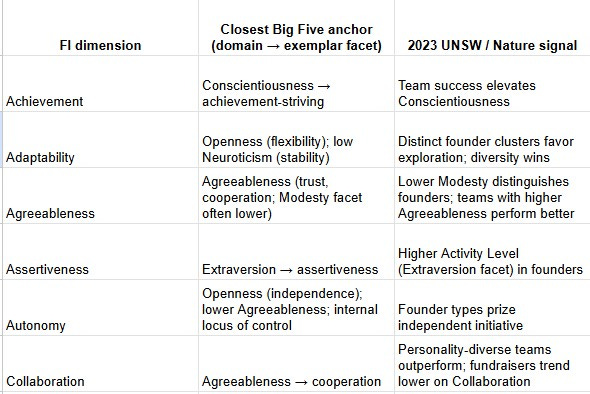
The mythology of entrepreneurship has always been convenient for investors and romantic for founders: anyone with grit, an idea, and caffeine can succeed. But data is increasingly cutting through the myth. A growing body of research confirms that personality traits, psychological wiring, and the composition of the founding team are among the most consistent predictors of startup success or failure.
That shouldn’t be surprising. Startups are not small businesses; they’re high-variance experiments in markets where 90% fail. What tips the balance between survival and collapse is rarely a spreadsheet (though, ironically, I’m going to give you a spreadsheet I’ve been playing with). It’s the behavior of people under uncertainty: how they react to setbacks, how they make decisions with incomplete information, and whether they can persuade others to follow them when the plan looks insane.
The question for founders and investors is no longer whether these traits matter, it’s how to measure them, how to build teams that complement them, and how to de-risk ventures by paying attention to Entrepreneurial DNA.
What the Research Shows
In October 2023, a research team at UNSW published a landmark study in Nature Human Behaviour. The conclusion was blunt: founders are distinct in personality from the general population, and those differences strongly predict startup outcomes. Successful entrepreneurs consistently exhibited higher levels of novelty-seeking, resilience, energy, and social vitality.
A 2022 systematic literature review in Frontiers in Psychology analyzed decades of entrepreneurial research and found five traits that most reliably predict entrepreneurial intention and performance:
Self-efficacy – the belief in one’s ability to execute and achieve.
Conscientiousness – being organized, disciplined, and persistent.
Locus of control – believing outcomes depend on one’s own actions, not chance.
Innovativeness – willingness to generate and try new ideas.
Need for achievement – motivation to meet and exceed challenging goals.
Classic meta-analyses of the Big Five personality traits (Zhao & Seibert, 2006, Journal of Applied Psychology) reinforce this: entrepreneurs tend to score high on openness to experience and conscientiousness, somewhat lower on agreeableness, and significantly lower on neuroticism. In practical terms: they thrive on novelty, manage tasks rigorously, are willing to challenge norms, and don’t fold under pressure.
Perhaps most importantly, a 2023 large-scale analysis of startup teams showed that personality diversity among co-founders increases survival rates and growth trajectories. Teams where all founders shared the same traits – say, three visionaries with no detail-oriented executor – fared worse than heterogeneous teams with complementary wiring.
I covered this years ago when work was increasingly published and Oxford rolled out their assessment of the need variety and novelty, reduced modesty, an openness to adventure, and heightened energy levels among founders, correlating those qualities with an exceptionally higher rate of success.
The implication is clear: you don’t need to be everything yourself (you can’t be) – but your team collectively does.
The opportunity is less well known: for more than a decade, the assessment of entrepreneurs has been readily available and ideal to idea stage entrepreneurs, all through a partner every startup ecosystem should have in place to identify and develop local entrepreneurs.
Entrepreneur DNA Assessment
Unlike legacy personality frameworks built for corporate HR (Myers-Briggs, DISC), both of which are meaningful, an assessment you all should using or providing was designed specifically to measure the behavioral traits that matter in entrepreneurial contexts.
The methodology draws on over 100,000 data points from founders worldwide, tracking which traits correlate with persistence through acceleration programs, venture creation, and fundraising outcomes. The assessment is structured across 25 dimensions of entrepreneurial potential.
The Dimensions of Entrepreneurial DNA
As I dug into the 25 Dimensions of Entrepreneurial DNA that Founder Institute developed, my MBTI-wired brain couldn’t help but notice that the varied research reinforces a few of the same qualities that all but determine success or struggle.
Some of the dimensions I’ve assessed can be grouped into categories that map directly to validated research:
Self-Belief and Drive: Self-efficacy, Need for achievement, Internal locus of control
Execution and Grit: Conscientiousness, Perseverance, Time management, Stress tolerance
Innovation and Creativity: Openness to new experiences, Ideation ability, Problem-solving flexibility
Risk and Adaptability: Risk tolerance, Ambiguity acceptance, Resilience after failure
Social and Leadership Capital: Persuasiveness, Networking ability, Leadership presence, Empathy and team orientation
Pragmatism and Market Focus: Customer orientation, Learning agility, Decision-making speed
These categories are not arbitrary; they overlay tightly with the peer-reviewed literature. This assessment is operationalizing research for startup contexts and while communities, startup development organizations, and universities continue encouraging entrepreneurship without this assessment in place, they’re effectively fostering failure by neglecting what might be the only sound science we have into what makes startups successful.
The Four Entrepreneur Types
This assessment clusters founders into broad “types” based on their dominant patterns. Typically, framed Visionary, Builder, Optimizer, or Strategist, the principle is that different founders succeed in different environments. This is why, I surmise, we have different types of founders defending their potential despite some personality assessments while we also find the ideal entrepreneurs failing despite having the right qualities. In the work you’re doing, deciding that someone is an entrepreneur isn’t sufficient to helping everyone succeed; your work can do so much more – developing the various circumstances (environments) in which different types thrive:
Visionary Innovators thrive in novel, uncertain markets but often need execution-driven co-founders.
Disciplined Executors keep the trains running but may under-invest in risk-taking.
Social Mobilizers excel at persuasion and team-building but need partners strong in technical rigor.
Pragmatic Optimizers scale existing models effectively but may resist radical innovation.
Again, research supports this segmentation. A 2023 UNSW study identified similar archetypes (novelty-seekers, exuberant initiators, disciplined operators) showing that startups with coverage across these archetypes had significantly higher performance.
And hopefully you can see yourself in a more or less ideal environment, if you’ve taken Founder Institute’s Assessment or at least evaluated your personality with one of the more broadly applicable evaluations. I find myself comfortable in environments where I can thrive being a Social Mobilizer or Visionary Innovator but burden me with existing models that resist change (where Pragmatic Optimizers excel). And notice, founders or cities, the deeper dive into Entrepreneurial DNA that partnering with Founder Institute provides, guides how to help startups develop the right teams – as a Social Mobilizer, someone like me needs a partner strong in technical rigor. Knowing this, and telling founders, isn’t criticism, it’s the meaningful advice that entrepreneurs are clamoring for among the noise of people yelling “Product Market Fit” and “CAC.”
Comparing Methodologies
I’ve referred to the more well-known evaluations so let’s compare a bit with familiar frameworks:
DISC helps explain communication styles, but it has limited predictive validity for entrepreneurial outcomes.
Myers-Briggs (MBTI) is popular in corporate environments, but psychologists rightly critique the inaccuracy of the countless test that people have created to capture your information (for years, I thought I was an ENTJ until I put more rigor into knowing myself). It can be a useful conversation starter but not a predictor of success if it’s wrong.
Rocket Fuel’s Visionary/Integrator model (Gino Wickman) offers a practical lens for pairing leadership roles but might simplify the founder’s psychology too much into a binary.
What the Entrepreneur DNA Assessment contributes is specificity: it measures exactly the traits most correlated with starting and scaling ventures, validated against outcomes. It doesn’t replace other tools, but it provides a more predictive base for founder development and team design.
For Founders AND Investors
Knowing your profile allows you to be intentional about co-founder selection and personal growth. The right takeaway is not “you don’t have what it takes,” but “you may need to pair with someone who has what you lack.”
For investors: founder assessment is often intuitive and biased – and it certainly shouldn’t be when we have decades of data and research correlating personalities without comes. Seriously, what investor in their right mind would neglect having this data in place? An empirical model grounded in psychology reduces subjectivity. It provides a structured way to identify which founders are more likely to execute, which teams are complementary, and where risk mitigation is needed.
For ecosystems and policymakers: entrepreneurial training programs often over-index on business planning and fundraising. The evidence suggests they should also emphasize founder psychology – coaching self-efficacy, resilience, and team composition. In much of my personal passion and work, I want to see this in place in your community so stop considering it and reach out to me to get it there.
Entrepreneurial DNA is measurable, and it matters. Ignoring it is akin to ignoring burn rate or runway. The Founder Institute’s DNA Assessment is one of the few tools designed to operationalize this science for founders in the real world.
Taking the assessment is not about vanity. It is about data: where you thrive, where you falter, and where you need others. In a market where the failure rate hovers at 90%, that knowledge shouldn’t be optional – and failing to expect it or provide it so that entrepreneurs can optimize their start, is neglect.
Entrepreneurial personality traits strongly predict startup outcomes. The question is whether founders and investors will choose to measure them or continue relying on instinct and charisma.
If you’re building a company, start by understanding your own entrepreneurial DNA, take the assessment to have one empirically grounded way to do so. Then build deliberately: not just a product or market strategy, but a team whose combined traits tilt the odds in your favor.
It isn’t the idea that fails. It’s the team’s psychology that cracks first.
Oh the spreadsheet!
I’ve been mapping different assessments together – you see a glimpse of it in the spreadsheet image above. If you’re curious or would like to contribute, message me and I’ll get you added…
Who are defining as entrepreneurs and startups in your data? Are you talking about investor-funded startups with very high potential, typically in the tech area? Or are you including the other 999 out of 1000 business owners who start most businesses that many call "small to midsize" businesses?
Thank you for publishing