

Every few months someone publishes a new piece declaring that AI will automate everything, that code is no longer a profession, that “vibe coding” (the practice of describing what you want to an AI assistant and accepting whatever it generates) is now a legitimate engineering strategy.
Last week, White House AI & Crypto Czar, David Sacks, shared some data that can’t go without scrutiny, “AI has dramatically lowered the cost of writing code, so it’s now being used across far more businesses, applications, and use cases.”

The people making the engineering argument are mostly confusing the application layer with what holds it up. They’re describing the cars while ignoring the roads.
Job Postings for Software Engineers are Rapidly Rising
Hopefully that headline makes you curious.
Bianca Schilling, Chief of Staff and Investor at Apprentis Ventures, published a framework earlier this year. Writing in Infra, her publication on deep technology as durable infrastructure, Schilling noted that “most technology narratives reward novelty. Products launch, features evolve, and attention shifts quickly. The story resets every cycle. Infrastructure behaves differently. It persists, supports, and compounds quietly over time.” Her argument was targeted at deep tech sectors: manufacturing, energy, healthcare, and logistics; she’s right about all of that. What I want to do here is expand her thesis significantly, because the principle she’s identified doesn’t just describe robotics and industrial software. It describes the entire economic architecture that AI and automation are built on top of, and it tells us something important about where the future of work actually lives.
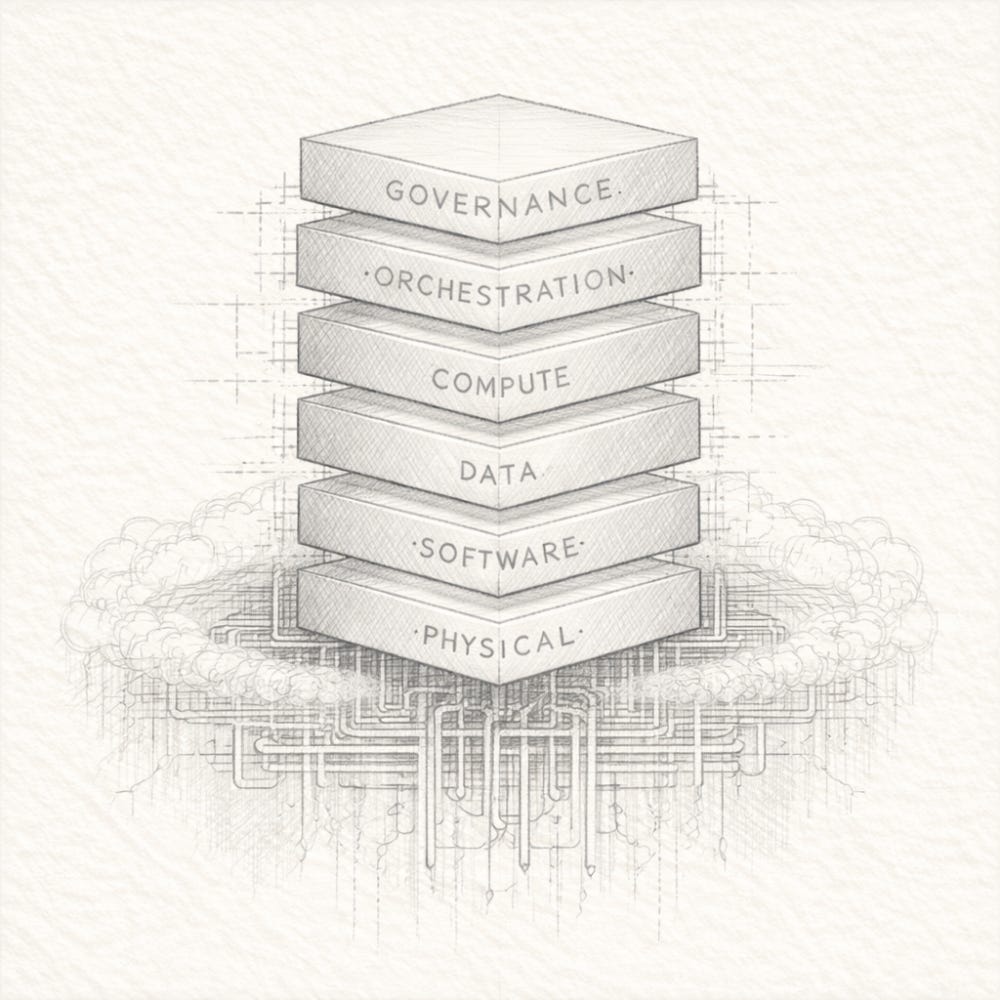
The diagram of her framework, above, is a map. Six layers, stacked from base to surface: Physical, Software, Data, Compute, Orchestration, Governance. It describes the technical stack of any complex system, whether that system is an industrial robot on a factory floor or a payment processing engine handling a trillion dollars a year in transaction volume. Read it from the bottom up and you see why the panic about AI replacing labor is, at best, half of a much more consequential story.
Infrastructure is the Future of Work
Let me explain not as she did but as I see it.
Physical is the layer that keeps everything else honest. It is hardware, sensors, actuators, network cables, server farms, manufacturing tolerances, and motion systems. In robotics, Schilling notes that “intelligence is constrained by physical reliability. Precision components, motion systems, and manufacturing tolerances determine whether software can perform consistently in the real world.” This is not a metaphor; a robotic arm with a 0.01mm positional tolerance requires mechanical design, materials science, thermal compensation engineering, and calibration routines that no language model can generate by prompting. A data center requires power delivery, cooling systems, fiber routing, and physical security, none of which exist in any codebase. The physical layer is the layer where weight, heat, friction, and electricity govern what is possible. AI has no jurisdiction there. Neither does a vibe coder.
Typically, infrastructure is appreciated as utilities and roads, or in tech, as servers and fiber cable. This is an outdated understanding; one which handicaps our economy, constrains policy, and misleads the public.
Software sits above physical but remains dependent on it completely. A confusion people somewhat carry is that software is all there is to technology now; after all, it’s in the cloud and on the internet. Of course, everyone understands that a smartphone is technology, but no one is angry at what semiconductors and touchscreens are doing, it’s the software concerning us. And perhaps it should concern us because software is the layer most susceptible to AI disruption precisely because language models were trained on code and can generate it at scale. This is the layer where vibe coding has a legitimate foothold: CRUD applications (Create, Read, Update, Delete, the basic logic of most business software), simple APIs, internal dashboards, marketing pages. These are real and genuinely automatable, but this is also the narrowest part of the stack in terms of economic value relative to what sits beneath it. Indeed even, countless startup founders are trying to launch their own ventures building this with AI in this rise of the solo founder; realistically, we’re seeing almost all of them fail because this app layer isn’t what matters. Software that runs on top of the physical layer without understanding what’s beneath it fails in production. Software that doesn’t connect with the next, the data layer, produces nothing worth using. The code generation capabilities of 2026 are impressive at the software layer; they don’t extend well beyond it.
Heck, I was doing this part myself back in 2002, and I can’t code.
Data is where AI’s relationship with infrastructure gets complicated because companies and executives want to own and control data as though it were their own. Data, in this “information age” is freely available, portable, accessible, and arguable belongs to many; it’s with data infrastructure that companies should be creating value. Besides, with AI, a language model generates text based on patterns learned from training data. It does not produce new data, and it does not accumulate operational data. It does not build data networks. Plaid’s bank connectivity represents a decade of institution-by-institution partnership agreements and data normalization across thousands of banking systems. Redox’s healthcare data exchange operates across 12,000 organizations after more than a decade of integration work. Stripe’s fraud model is trained on transaction patterns from millions of businesses across trillions of dollars in volume. You see, Infrastructure as a Service builds the most defensible economics, no language model generates that expertise nor those relationships. The data layer is defined by accumulation, by real transactions, real behavior, and real institutional relationships over real time; you cannot prompt your way into it.
Compute is the layer that makes AI possible in the first place, which should immediately clarify why AI doesn’t replace it (and why everyone needs to reframe their understanding of infrastructure in a country). Large language models require massive GPU clusters, specialized cooling infrastructure, network fabric designed for low-latency inter-chip communication, and custom silicon architectures (Google’s TPUs, AWS’s Trainium) built specifically for tensor operations at scale (I don’t even know what tensor means, but that’s what it does… and my not knowing is my point that we need to do a better job of understanding these dependencies of the future). A model that can write a React component cannot provision or maintain the hardware that runs the inference serving that makes the model respond at all. The compute layer is capital-intensive, physically constrained, and operationally demanding in ways that produce exactly the economic characteristics Schilling describes: longer sales cycles, slower adoption, stronger retention, and compounding relevance as switching costs accumulate. Nobody is vibe coding their way to a GPU cluster.
I genuinely wrote that with buzzwords which even I’m not familiar. The point is that this is knowledge dependent work. I can vibe code a better CRM now… but I have little idea of all that goes into such a thing actually working technically as a valuable and scalable company; it’s certainly nothing one person alone can accomplish.
Orchestration is the coordination layer, and it is the layer that should most clearly expose this; the gaps between AI demos, AI products, and successful companies using AI. Orchestration is the software systems that manage workloads across distributed resources: Kubernetes (the open-source system that automates deployment and scaling of containerized applications), Apache Kafka (a real-time data streaming platform), workflow engines, job schedulers, service meshes that route traffic between microservices, and observability platforms that monitor what everything is doing. In industrial AI systems, Schilling describes this as the need for “continuous infrastructure: compute, orchestration, data pipelines, and governance that holds up under real operational load.” That phrase, “real operational load,” is doing more work than it might seem; a demo that works beautifully in a controlled environment and a system that handles 50 million events per day at sub-100-millisecond latency with 99.99% uptime are not the same thing. The engineering required to build the second one is not automatable by the tools that build the first one. Orchestration under operational load requires deep systems expertise, failure mode analysis, and iterative production experience that accumulates over years of operating real systems at scale.
Governance is the top of the stack and the layer most frequently dismissed by founders who would rather ship than comply (which, granted, rather defines what makes someone an entrepreneur). Governance covers regulatory compliance, data privacy frameworks, audit trails, access controls, model explainability requirements, and the institutional trust relationships that make critical systems permissible to deploy at all. In healthcare, deploying an AI diagnostic tool requires FDA clearance pathways, HIPAA (Health Insurance Portability and Accountability Act) compliance infrastructure, clinical validation studies, and institutional review processes. In financial services, the AML (Anti-Money Laundering) and KYC (Know Your Customer) compliance requirements come with nine-figure fines for getting them wrong: Klarna Bank paid approximately $45 million in December 2024 for inadequate AML controls; City National Bank paid $65 million in January 2024 for failing to maintain effective risk management. AI can assist with governance workflows; it cannot replace the institutional knowledge, regulatory relationships, and operational track records that make governance credible to regulators and partners. The governance layer compounds in value because trust accumulates slowly and disperses quickly.
Why Bianca’s Thesis Extends Far Beyond Deep Tech
Schilling frames this as a lens for understanding deep technology specifically: “manufacturing, energy, healthcare, logistics, life sciences, and space operate under structural constraints. In these environments, technological systems embed beneath operations, economics, and institutional processes.” This is accurate. It is also a description of every sector where infrastructure economics apply, which is to say, every sector where the stack above exists in any recognizable form.
Consider the six-layer model applied not to an industrial robot but to a fintech company processing payroll.
Physical: data centers, network infrastructure, banking rails, ACH (Automated Clearing House) network hardware.
Software: the application layer, the part a vibe coder might recognize.
Data: payroll transaction history, employer tax records, employee compensation data, tax authority integration points.
Compute: the processing capacity required to run payroll for thousands of employers simultaneously, with cryptographic security and compliance logging.
Orchestration: the workflow engines that sequence direct deposit timing, tax withholding calculation, and regulatory filing against federal and state deadlines.
Governance: IRS reporting requirements, state tax agency integrations, SOC 2 compliance, and the banking partnerships that make ACH access possible.
The infrastructure is actually found in all that’s beyond the Software layer, in Schilling’s sense: durable, embedded, and operationally indispensable. When Stripe describes itself, it doesn’t say “payment processor.” It calls itself “financial infrastructure for the internet.” That framing is not marketing; it is an accurate description of which layers of the stack the company owns.
I’ve explained the same workforce technology; so, in one respect, I mean it literally when I say understanding this is the future of work. For example, MustardHub is the infrastructure layer for behavioral workforce intelligence; it embeds inside existing HR systems and generates the behavioral signal that transactional platforms were never designed to produce. It’s connecting dots between the Data, Compute, Orchestration, and Governance layers, for Software. Take Human Capital Management platforms or Applicant Tracking Systems which record events (a hire logged, an offer extended, a performance review filed, a separation processed). What they cannot see, and were never designed to see, is behavioral signal between such events. That signal lives in the data layer of the workforce stack, accumulated across employers and industries over time, in ways that no single platform builds on its own and no language model produces from a prompt. The economic defense of this position comes directly from the stack: the data is proprietary, the ML pipeline is specialized, and the integration depth creates switching costs that compound with time. That is infrastructure economics applied to workforce, and it is exactly what Schilling is describing when she says that technologies with these characteristics exhibit “stronger retention” and “compounding relevance.”
Infrastructure as a Service Builds the Most Defensible Economics; Most Investors Are Looking at the Wrong Companies… take a look:

What AI and Vibe Coding Actually Displace
This requires acknowledging what the automation wave is doing correctly.
AI does displace real labor at the software layer, and the software layer represents a substantial portion of current technology employment. Application development, internal tooling, marketing site generation, basic API integration, data formatting and transformation, test case generation: these are real categories of engineering work where AI productivity gains are genuine and significant. A founder who needs a dashboard built in 2026 has fundamentally different options than a founder in 2019; that difference is real and compounds over time as models improve.
The World Economic Forum’s Future of Jobs Report 2025 found that while 41% of employers expect to reduce headcount where AI can automate tasks, 77% plan to reskill or upskill workers rather than replace them entirely, consistent with Sacks’ share. The net projection is 78 million new jobs globally by 2030, driven by roles requiring cross-domain judgment, systems thinking, and the kind of institutional knowledge that accumulates through operational experience rather than training data. The WEF analysis is consistent with the stack model that the jobs that survive and multiply are the jobs in the layers AI cannot own.
An interesting paradox is that AI acceleration at the software layer increases the relative value of the layers below.
When any competent founder can generate a working application in a weekend, the competitive advantage of having a better application interface compresses dramatically. The competitive advantage of owning the data layer, the compute infrastructure, the orchestration systems, and the governance relationships that make a production-grade service possible: that advantage expands. Schilling captures this when she observes that the defensibility of these systems “comes from integration, trust, and operational dependence, not speed alone.” Speed is precisely what AI provides at the software layer. Integration, trust, and operational dependence are precisely what AI cannot generate.
Infrastructure as a Service: The Economic Architecture of This
The traditional expression of Infrastructure as a Service (IaaS) covers the compute infrastructure businesses rent instead of building: servers, storage, networking, delivered by AWS, Azure, or Google Cloud; the concept has expanded substantially beyond that. The Salesforce IaaS overview is accurate but also insufficient; Infrastructure as a Service today describes any capability that other companies build products on top of, rather than a finished product users consume directly.
By 2027, APIs are projected to contribute $14.2 trillion to the global economy, more than the GDP of the UK, Japan, France, and Australia combined. Most of that runs through companies that live in the infrastructure layer, not the application layer above it. These companies exhibit every characteristic Schilling identifies as the hallmark of infrastructure: longer sales cycles, slower initial adoption, stronger retention, and compounding relevance as their integration depth increases. API-first companies command a 25% valuation premium, and companies with mature API strategies see 12.5% higher revenue growth. That premium is not about code quality. It is about stack position: infrastructure companies own layers that application companies depend on, and dependency creates defensibility that no product feature can replicate.
The IaaS economics also explain why AI cannot displace this category in the way it displaces application-layer software. Stripe’s fraud model is trained on transaction data from millions of businesses across trillions of dollars of volume. Redox’s healthcare data exchange network took over a decade to build across 12,000 organizations. Plaid’s bank connectivity came from years of individual institution agreements. These are data and relationship assets that no language model produces. They accumulate through operational experience in production environments at scale. They are, to use Schilling’s framing, systems that “become embedded infrastructure” through “integration, trust, and operational dependence.”
Where the Future of Work Actually Lives
Extended across the full stack, the framework Schilling provides, tells us something specific about where employment compounds over the next decade. It is not in the software layer, where automation pressure is real and intensifying. It is in the layers that make the software layer meaningful: the physical systems that require mechanical, electrical, and materials engineering; the data pipelines that require operational expertise and institutional relationships; the compute infrastructure that requires systems engineering and supply chain depth; the orchestration systems that require production experience under real load; and the governance frameworks that require regulatory knowledge, institutional trust, and accountability that no model can absorb through training.
These are not abstract categories; they are jobs:
Systems reliability engineers who understand failure modes at scale
Data engineers who build pipelines that hold up under operational load across disparate institutional data sources
Hardware engineers working on the compute infrastructure that makes AI inference economically viable
Regulatory specialists who navigate the governance layer in healthcare, employment, financial services, and critical infrastructure
Orchestration architects who keep distributed systems running when they’re handling real production traffic
The people doing this work are not being displaced by AI; they are being made more valuable by it, because every dollar AI spends at the software layer increases the dependency on the infrastructure layers below.
Schilling wrote that “deep technology becomes most powerful when it disappears into the background and enables others to build on top of it.” That observation extends across the entire stack. The most valuable infrastructure is the infrastructure nobody thinks about until it fails. These systems disappear into the background not because they are unimportant but because they work, and they work because the people who built and maintain them accumulated the expertise and operational experience that no prompt generates.
The future of work is not in the visible product layer; it’s in the layers that hold the visible product layer up. And the deeper you go in that stack, the harder it is to automate, the more it compounds in value, and the more permanently it embeds itself in the economic architecture that everything else depends on.
If you’re a founder trying to figure out which layer you’re actually building, an investor trying to identify where the real moats are, or an economic developer trying to decide which companies in your region are worth backing for the long term, that stack diagram is not a taxonomy exercise; it is a map of where durable value lives. Bianca Schilling built the map for deep tech… the rest of us run on the same dependencies.