

The sequence almost every city follows when it decides to “do something” about entrepreneurship seems the same:
Hire a director,
Launch an accelerator
Host a pitch competition
Put out a press release about becoming “the next Silicon Valley”
Wonder eighteen months later why founders are still struggling to
Rest assured, your community is doing something like this. I’ve seen the NSF grant announcements, I just heard that a nearby city hired a Head of Innovation (who used to work at McKinsey), and, with autumn around the corner, cities are announcing their Startup Week programming and asking for submissions for the awards and demo days.
Nobody ever asks what’s wrong. No one ever publishes a plan or a press release that isn’t a celebration of startups (or innovation) but is rather, a finding of what doesn’t work and what they plan to do about it. Oh, I know you THINK you did an assessment of what to fix; you probably even claim you did, have data to prove it, and can share the name of the consultant you hired that will agree with you.
In my 25 years of working with cities about startup programs, of one thing I can be certain, none of you have ever actually done so. I have never spoken with a city that knows what’s wrong or isn’t surprised (or grateful) to hear what they should be working on.
I get a kick of how many social media posts by cities celebrate from the Pitchbook / Carta / Government lists announcing the top 10 whatevers… but have you ever seen anything meaningful about the bottom 10 in venture capital? The 10 cities struggling with startups? The 10 sectors of the economy in desperate need of innovation?
Of course not. No one wants to expose what’s wrong. But, because of that, no one is working on what needs to be fixed; everyone is reinforcing the good while ignoring what needs work.
Audit your Startup Ecosystem
In the past few years, I’ve done dozens of regional startup ecosystem audits and despite what you think you have assessed, I know for a fact that none of you have what is needed.
In the sector of our economy in which almost everything fails, working on what isn’t going well is FAR more important than celebrating what is humming along. Especially if you work for the City / Government / Association / VC, founders need your support fixing what’s wrong, not congratulating everyone that you have an Angel Group.
Think of it this way, you have the equivalent of a surgeon opening you up before ordering an X-ray, except the patient is your regional economy and the anesthesia is putting everyone to sleep so they don’t complain that you’re not doing a very good job.
Jonathan Chambers, an economic development and ecosystem builder whom ESHIP Alliance profiled as an influential connector, has become a driving force in the entrepreneurial landscape through his commitment to supporting founders and strengthening collaborative networks, has spent his career pointing out a version of this same problem; that, ecosystems get built by a handful of enthusiastic people before anyone has actually diagnosed what the ecosystem needs. As Chambers put it discussing how most ecosystems form, nearly every regional startup effort of the last two decades “started with a few charismatic connectors,” which is a nice way of saying most cities have been improvising for twenty years and calling it strategy, while under-supporting local leaders who are actually doing the work.
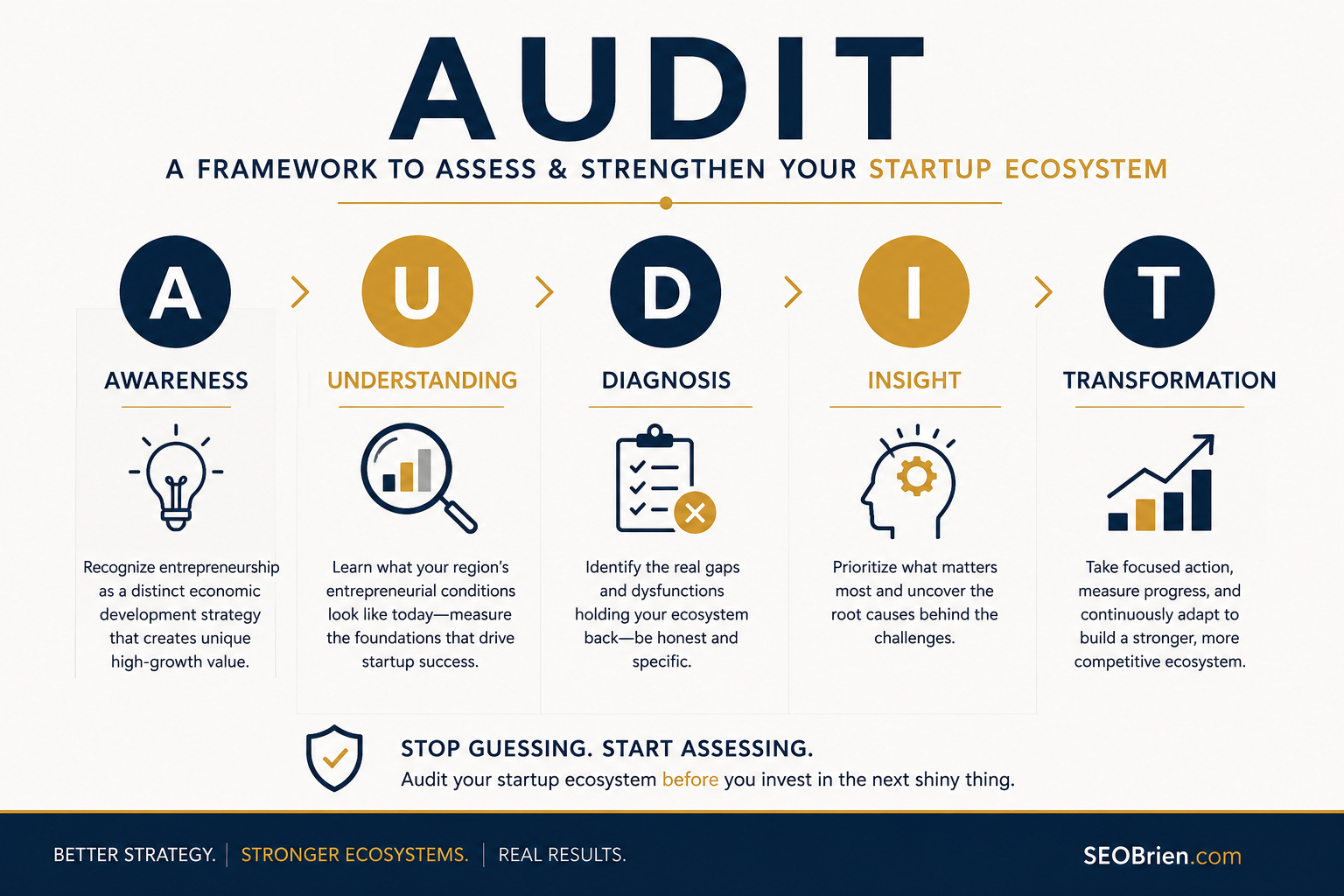
Chambers and I were talking recently and came up with a meaningful acronym for AUDIT, relevant to economic development in this context. This AUDIT reframes ecosystem development the way a competent internist reframes that patient consult; you don’t cut open until you assess, you don’t prescribe until you diagnose, and you don’t diagnose until you actually look. AUDIT stands for Awareness, Understanding, Diagnosis, Insight, and Transformation, and it’s a sequence, not a menu. Skip a step in your startup ecosystem assessment and the rest of the framework collapses, the same way a construction crew can’t pour a foundation without first knowing the soil composition, the water table, and whether the parcel next door is about to become a landfill.
I’m begging you to stop putting taxpayer dollars into that innovation hub that wins headlines while you have no grasp of whether or not the ecosystem can and will actually sustain it. Following AUDIT:
Awareness is the recognition, inside a city, region, or state, that entrepreneurship is an economic development strategy in its own right, distinct from small business support, workforce programs, or corporate recruitment. Most places never get past this stage; they fund a coworking space and call it an ecosystem strategy, which is a little like buying a treadmill and calling it a fitness plan. Awareness means the mayor’s office, the university, the chamber, and the capital sources all recognize that high-growth startups create a different kind of value than a new restaurant on Main Street, and that value requires different infrastructure.
Understanding is where you actually learn what your region’s entrepreneurial conditions look like today, not what you assume they look like based on the last press release from the state’s economic development office. This is where you’re honestly assessing whether you have the foundational conditions laid out in The 6 Considerations of the Economic Development of Startups: a culture that rewards competitive risk-taking, real wealth in the region, employers innovative enough to give founders somewhere to land if they fail, minimal government friction, people who have actually worked inside startups rather than small businesses, and a credible, honest story about what your region is actually good at. Understanding means you stop guessing and start measuring.
Diagnosis is the uncomfortable part, because diagnosis means naming what’s broken instead of what’s merely absent. A city can have plenty of activity, demo days, meetups, an “innovation district” with a nice sign, and still have a diagnosably sick ecosystem if none of that activity produces founders who reach revenue, capital that recirculates locally, or mentors who actually know the difference between advising a startup and advising a small business. Diagnosis is where you find out your ecosystem doesn’t have a marketing problem, it has a structural one, which is a distinction most consultants are financially incentivized never to make for you.
Insight is what you get once diagnosis has told you what’s actually broken and you translate that into a specific, prioritized set of interventions, in the right order, for your region’s particular conditions. Insight is not a generic playbook borrowed from Austin or Boulder; regions are not software, they don’t run on someone else’s code, and pretending otherwise is why so many “innovation strategies” read like they were written by consultants who’ve never met the region they’re advising.
Transformation is the fifth letter, and it is deliberately the only one of the five that isn’t research. Transformation is implementation, it’s the actual building, funding, and operating of the organizations, programs, and policy changes that Insight identified as necessary. It requires different skills than the first four letters entirely; it requires ecosystem builders, program operators, capital allocators, and policy staff who can execute over years, not analysts who can diagnose over months.
That last distinction is the entire point, and it’s why our regional ecosystem assessment work is built around exactly the first four letters identified in Chambers’ framework.
What we do as Startup Economists, having worked now with regions from Liège to Croatia to Colombia to Kansas City, are the Awareness, Understanding, Diagnosis, and Insight phases of a genuine audit; call it AUDI, which admittedly sounds like a car company, but the analogy actually holds up better than you’d expect. You wouldn’t ask the mechanic who diagnoses your transmission to also be the one who spends the next three years driving the delivery routes. Diagnosis and operation are different disciplines requiring different people and conflating them is why so many regional “strategic plans” get written, printed, celebrated at a press conference, and then shelved because the people who wrote the plan were never equipped, funded, or positioned to run the plan.
Please hear me when I advise you that you have to do this, because you aren’t.
I sit in meetings with city officials who start by applauding their local accelerator only to then admit, “yeah… it really isn’t working.” I’m tired of hearing Chamber of Commerce tell me they have a funding problem while the local Angel Group has an office right next door. The next time I visit the celebrated Innovation Hub, to find it practically empty, I’m going to scream.
You all are launching a Startup Incubator because that’s what Bentonville, has, and no one stopped to ask if that’s what you ACTUALLY need, that is what will work, and that you have the other aspects of an ecosystem so that the incubator is even capable of working.
The AUDI work of a complete AUDIT isn’t guesswork dressed up as expertise, either; it’s built directly on the same two frameworks published and used to structure meaningful startup ecosystem development engagements. The Understanding phase runs directly against the Six Considerations; a region that thinks it has a “founder problem” often actually has a wealth problem, or a government-interference problem, or worse, no credible answer to what kind of startups it should even be attracting. And the Diagnosis and Insight phases map directly onto the ten dimensions of entrepreneurial capacity outlined after seeing the same pattern repeat across New Mexico, Alberta, Queensland, Lisbon, and Tulsa; silos that keep every organization operating in its own bubble, a missing middle where high-growth companies fall into a gap between accelerator graduation and Series A, ecosystem builders who are underfunded to the point of burnout, metrics that track activity instead of outcomes, collaboration that has to be negotiated instead of assumed, invisible talent nobody bothered to go find, environments that don’t actually let people perform, government and academia and the private sector that don’t talk to each other, regions chasing trendy sectors instead of their own comparative advantage, and global best practices copied instead of adapted.
Ten dimensions, and a proper AUDI tells you specifically where your region is struggling, in what order or priority, and why. That’s the map. Diagnosis without a map is just an opinion with a nicer font.
The sequence matters; most regions get this backward as cities routinely start at Transformation.
Don’t Start with the T! Don’t Even Keep Doing T if you are Now
You fund the accelerator, hire the director, and launch the innovation district, all without ever doing Awareness, Understanding, Diagnosis, or Insight first.
I’m just full of analogies today so here’s another one; you’re a gambler walking into a casino, skipping the odds entirely, and betting the mortgage on whichever table has the loudest crowd around it.
Then when by sheer luck, it works, you claim a win which then, thanks to an accident, causes the region to spend the next decade telling a survivorship-bias story about how their one lucky bet was actually a strategy. Most of the time it doesn’t work, and the region spends the subsequent decade wondering why the accelerator graduated forty companies and none of them are still headquartered locally (even they even still exist).
Do the AUDIT now, or again if you want to think of it that way; it’s not an argument about process for its own sake.
It’s an argument about capital efficiency. Every dollar a region spends on a program built on a wrong diagnosis is a dollar it can’t spend on the program that would have actually worked. Every year a well-meaning economic development office spends running events instead of fixing the structural gap in early-stage capital is a year founders spent leaving for a region that did the diagnostic work first. Transformation is genuinely exciting; it’s ribbon cuttings and headlines and the part everyone wants to be at the podium for. But Transformation without Diagnosis is theater, and theater doesn’t recirculate capital.
Has anyone working for your city, in the economic development office, through your university, at your chamber, or in your capital community ever formally answered what’s broken, specifically, in what order, before deciding what to build next? I would bet I can answer that question for you because I have never encountered a city that has done it, regardless of what they say. Your region, like most, simply started at Transformation because a consultant provided sufficient affirmation that they should and because Transformation is the part that photographs well.
If you’re an ecosystem builder, a policy professional, or an investor looking at a region and sensing that something structural is off, but you can’t quite name it, that instinct needs to be taken seriously rather than talking yourself out of it. That’s usually Diagnosis trying to happen without the tools to finish the job.